Sell a Junk, Damaged, or Non-Running Car — Nationwide
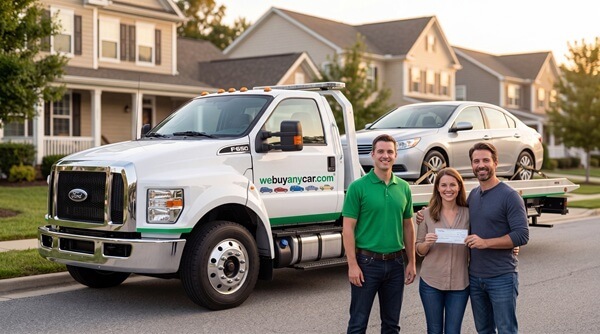
If your car doesn’t run, has been in an accident, or has simply reached the end of the road, We Buy Any Car will still buy it. Enter your vehicle details online, get a valuation, schedule a free pickup, and get paid by check the moment our driver arrives. No repairs needed. Pickup and towing cost nothing. No trips to a branch.
How It Works: Four Steps to Selling a Junk Car
| Step | What Happens | Your Time |
|---|---|---|
1. Get your valuation | Enter your vehicle’s year, make, model, mileage, and condition at webuyanycarusa.com. Our valuation tool calculates an offer based on real market data. If your car doesn't run, answer no to "Does Your Car Run and Drive?" and you'll see the options available in your area. | ~1 minute |
2. Schedule your pickup | If your vehicle qualifies for pickup, you’ll be prompted to schedule a convenient time online. Self-service booking — no phone call required. | ~2 minutes |
3. We come to you | A driver arrives at your chosen location on the scheduled date. They confirm your vehicle matches the year, make, and model you provided. | You’re present for pickup |
4. Get paid on the spot | Once confirmed, the driver hands you a check for the agreed amount. Your vehicle is loaded and taken away. Done. | ~10 minutes |
Why Sell Your Junk Car to We Buy Any Car
Free pickup. We arrange and cover the pickup, so you never have to find or pay for a tow truck.
Paid on the spot. The driver hands you a check for the agreed amount when we take ownership of your car.
Find out what it's worth in about a minute. Enter your details online and see your valuation before you book anything.
Sell it as it sits. Running or not, damaged or rusted out, you don't need to fix anything first.
Booked online. Pick a pickup time yourself. No phone call required.
Valued on your car's details. Your valuation is based on the year, make, model, mileage and condition you enter.
What Kinds of Cars Do We Buy?
We buy vehicles in a wide range of conditions, including:
Cars that won’t start or can’t be driven
Vehicles with accident or collision damage
Cars with flood, fire, or weather damage
High-mileage vehicles no longer worth repairing
Older vehicles that have failed inspection
Cars with major mechanical problems — blown engines, transmission failure, and similar
If the vehicle at pickup differs from what was entered online, the agreed amount may need to be adjusted to reflect the actual vehicle.
Not sure if your vehicle qualifies? Start with a free online valuation. Our system will let you know whether your vehicle is eligible for pickup during the process.
How You Get Paid
Payment is by check, brought by the driver at the time of pickup. The check is for the amount agreed during your online valuation. We pay by check at the point we take ownership.
There is no additional cost to you for pickup. We Buy Any Car arranges and covers the pickup of your vehicle.
Getting Ready for Pickup
A few minutes of preparation keeps pickup quick.
Have your title on hand. Signing rules vary by state. Find yours in the list below.
Be there at the scheduled time. The driver confirms the vehicle with you and hands you the check.
Do a final sweep for your belongings. Clear out your things before pickup day, then take one last look in the glovebox, trunk and under the seats for anything you missed, including garage door openers and toll transponders.
Make sure the driver can reach the car. A driveway or the street works best. Avoid locked gates or tight spaces a tow truck can't get into.
Proof of Ownership
To complete the sale, you’ll need to demonstrate ownership of your vehicle. In most cases, that means your signed vehicle title. Signing requirements vary by state — select yours below for step-by-step guidance:
Lost your title? You’ll need to obtain a replacement from your state’s DMV before pickup. Most states process replacement titles within a few days to a few weeks. The link above for your state includes guidance on the replacement process.
When Is a Car Considered Junk?
Not every old or high-mileage car is a junk car. A car is generally considered junk when damage or mechanical failure has left it unable to run, or too unsafe to drive on public roads. That covers everything from a car that won't start at all to one that still starts but has problems too serious to trust on the road.
Common signs your car has reached that point:
The repair bill would be more than the car is worth
It won't start, or it can only move on the back of a tow truck
A major part has failed, such as the engine or transmission
It failed a safety or emissions inspection and the fix isn't worth paying for
Your insurance company declared it a total loss
It has been sitting unused for months or years
Rust or frame damage has made it unsafe to drive
A junk car is not a worthless car. It still has parts, metal and market value. It just needs a buyer who will come and get it.
What Is a Junk Car Worth?
There is no single price for a junk car. What yours is worth depends on a handful of factors, and every buyer weighs them a little differently.
| Factor | Why it matters |
|---|---|
Year, make and model | Popular models tend to have more demand for their parts, which can mean more value as a whole vehicle. |
Condition and damage | What is wrong with the car, and how much, changes what it is worth to the next owner. |
Major components | Whether the engine, transmission and catalytic converter are still on the car. Missing parts can often mean a lower value. |
Mileage | Lower mileage parts have more life left in them, so they potentially could be worth more to certain buyers. |
Size and weight | Heavier vehicles contain more metal, which matters most when a car is priced as scrap. |
Scrap metal prices | Steel and other metal prices move with the market, so scrap based offers rise and fall with them. |
Location | Local demand, and how far the car has to travel, may affect what buyers in your area can offer. |
One reason values vary so much from buyer to buyer: some buyers price a car on its metal weight alone, while others also look at whether the car or its working parts can be resold.
The quickest way to find out what your car is worth is a free online valuation. It takes about a minute, and you see your offer before you book a pickup.
Your Options for Getting Rid of a Junk Car
If your car is truly at the end of the road, you have more than one way to get rid of it. Here is how the main options compare.
| Option | How the price is set | Towing | How you get paid | Good to know |
|---|---|---|---|---|
Sell to We Buy Any Car | Online valuation based on market data for your year, make, model and condition | We arrange and cover the pickup | Check from the driver at pickup | Booked online. The amount may be adjusted if the car differs from what you entered. |
Junkyard (salvage yard) | Usually the value of the usable parts plus the scrap metal | Some yards tow, others ask you to bring the car in | Varies by yard | Offers can differ a lot from one yard to the next, so it pays to compare. |
Scrap metal yard | The weight of the metal at that day's scrap prices | Usually you deliver the car | Varies by yard | The price follows the metal market, not the make or model. |
Car donation | You are not paid for the car | The charity usually arranges the tow | No payment; you may qualify for a tax deduction | If the charity sells the car, your deduction is generally limited to what it sold for. |
Dealer trade-in | Set by the dealer as part of buying another vehicle | You get the car to the dealer | Credit toward your next vehicle | Only an option if you are buying, and many dealers won't take a car that doesn't run. |
State vehicle retirement program | An incentive set by the state program | Usually delivered to a licensed dismantler | Paid through the program | Only offered in a few states, with strict eligibility rules. |
Junkyard vs. Scrap Yard: What's the Difference?
The two names get used for the same thing, and plenty of businesses do both, but they work differently.
A junkyard, also called a salvage yard or auto recycler, buys whole vehicles. It pulls the parts that still work, such as engines, transmissions, body panels and wheels, and resells them. Some let customers come in and pull parts themselves. Because those parts have value, a junkyard's offer can reflect more than just the metal.
A scrap yard, or scrap metal recycler, buys metal by the pound or the ton. It doesn't resell parts, so a car is priced on how much it weighs and what metal is paying that day. Scrap yards often expect you to bring the car to them.
In practice the two are steps in the same chain. Once a junkyard has pulled the useful parts, what is left of the car usually goes to a scrap yard to be crushed and recycled.
Donating a Junk Car
Donation suits people who would rather support a cause than get paid. Keep in mind that you only benefit at tax time if you itemize your deductions, and if the charity sells the car, the deduction is generally limited to the sale price (IRS Publication 4303). Selling puts the money in your hand the day the car is picked up.
State Vehicle Retirement Programs
A few states pay to take older, high-polluting cars off the road. California is the main example: its Consumer Assistance Program pays to retire a car through a licensed dismantler. Others, such as Colorado, offer an incentive to scrap an old car only when you replace it with a cleaner one. These programs come with income, emissions test or registration requirements, and many require the car to start and drive, so they rarely fit a car that needs a tow.
Frequently Asked Questions
Find Junk Car Pickup Near You
We offer vehicle pickup across most of the U.S. Select your state or city below for local service information.
By State
Cities and Metro Areas
webuyanycar.com serves customers across the United States with convenient locations and at-home service where available. Get started with your free online valuation.